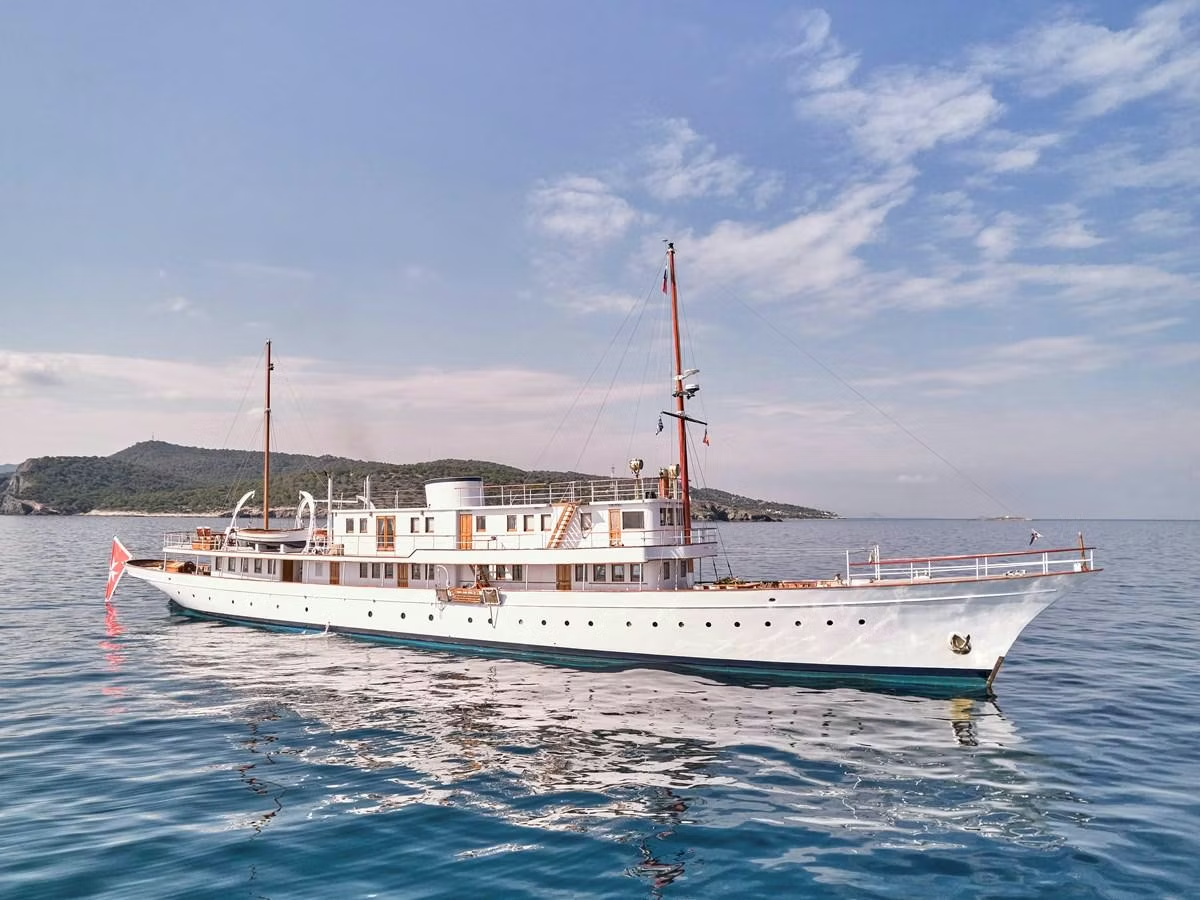

Azimut and Princess often appear on the same shortlist. Both build premium motor yachts across similar size ranges, both have a strong presence in the Mediterranean, and both are well represented on the pre-owned market.
But they do not approach yacht design in quite the same way.
Azimut tends to offer a broader spread of yacht concepts, from conventional flybridge models to sportier and longer-range designs. Princess takes a more clearly segmented approach, with distinct ranges for flybridge, sports yacht, sportbridge and larger cruising yachts.
The right choice depends less on which badge you prefer and more on which individual yacht works best for the way you plan to use it.
You can compare current Azimut yachts for sale and Princess yachts for sale through UNICO Yachting.
Azimut vs Princess: The Main Differences
Azimut | Princess | |
|---|---|---|
Design | Contemporary and often more expressive | More restrained and understated |
Range | Very broad mix of yacht concepts | Clearly defined model families |
Flybridge yachts | Major part of the range | One of the brand's core strengths |
Performance yachts | Several sport-oriented options | Strong V and S Class offering |
Long-range concepts | Magellano and other crossover models | Less directly focused on crossover designs |
Pre-owned choice | Extensive | Extensive |
Best choice | Depends on model and intended use | Depends on model and intended use |
These differences become more useful once you stop comparing the brands as a whole and start comparing the yachts you could realistically own.
Design and Layout: Italian Expression vs British Restraint
Azimut is often the more visually expressive of the two. Large areas of glazing, sculpted exterior lines and strong connections between indoor and outdoor spaces feature heavily across much of the range.
Princess tends to take a more restrained approach. The design language is usually cleaner and less dramatic, with considerable attention given to practical circulation, helm ergonomics and how owners and guests move around the yacht.
Neither philosophy is inherently better.
A yacht can look spectacular at a boat show but still frustrate you after a week aboard.
When viewing either brand, look beyond the finishes. Can guests move from the cockpit to the flybridge easily? Are the side decks wide enough to use comfortably? Is the galley in the right place for the way you entertain? Can somebody prepare breakfast without blocking the main saloon walkway?
These are small details during a viewing but significant ones during ownership.
The Biggest Difference May Be the Range, Not the Yacht
One of the biggest differences between Azimut and Princess is how each builder structures its range.
Azimut gives buyers several quite different directions to explore. Someone initially looking at an Azimut Fly may later realise that a Magellano better suits longer passages, or that a sportier S-series yacht fits how they actually spend their weekends.
Princess makes the decision tree somewhat easier to understand.
Its F Class is centred on flybridge cruising, V Class focuses more heavily on open sports-yacht characteristics, S Class blends performance with an upper sportbridge, while the larger Y and X ranges cater for buyers wanting increased volume and longer stays aboard.
This matters because buyers frequently start by saying:
“I want a 60-foot yacht.”
A better starting point is:
“What do I want my 60-foot yacht to do?”
The answer often narrows the shortlist far faster than choosing between Azimut and Princess.
Performance and Seakeeping: Compare Models, Not Badges
Statements such as “Princess handles better” or “Azimut is sportier” are too broad to be genuinely useful.
Hull form, weight, propulsion, engine package and model generation all influence how a yacht behaves.
A performance-oriented Azimut should not be judged against a Princess flybridge yacht designed for a different type of cruising. Likewise, a Princess V-Class yacht and an Azimut Magellano might have similar lengths but very different priorities.
When comparing two yachts, look at:
cruising and maximum speed
shaft or pod propulsion
fuel capacity and realistic range
stabilisation
engine-room access
manoeuvrability in harbour
noise and vibration at cruising speed
On a pre-owned yacht, service history matters just as much.
A sophisticated propulsion package is valuable when properly maintained. Without documented servicing, it can also become one of the largest financial risks in the purchase.
A professional pre-purchase yacht survey should therefore form part of either purchase.
Which Azimut and Princess Models Should You Compare?
The most useful comparisons tend to happen within a similar size and use case rather than between model names.
A buyer around the 50-foot mark might consider an Azimut Fly 50 alongside a Princess F50. Move slightly larger and models such as the Azimut Fly 53 and Princess F55 may enter the same search.
At around 70 feet, an Azimut Fly 68 or Fly 72 could overlap with Princess F or Y Class options depending on how much interior volume, performance and crew accommodation the buyer wants.
Sportier buyers may instead compare Azimut S-series yachts with Princess V or S Class models.
These should be treated as shopping alternatives rather than exact equivalents.
Before comparing models, decide your:
purchase budget
realistic annual running budget
required cabins
crew requirements
cruising area
expected passage lengths
The shortlist usually becomes much smaller once those questions are answered.
Look at Usable Space, Not Just Yacht Length
Length overall is one of the first figures buyers compare.
It can also be one of the most misleading.
Two yachts measuring roughly 70 feet may provide noticeably different amounts of space where you actually spend time.
Instead of asking which yacht is bigger, look at what we might call its usable space per foot.
Walk through the yacht and consider:
cockpit depth
flybridge seating and dining space
usable foredeck area
saloon circulation
cabin floor space
side-deck width
crew accommodation
tender storage
engine-room access
Exterior styling can also influence how volume is distributed. A dramatic profile may create exceptional spaces in one area while compromising another. A more conventional hull and superstructure may use the same overall length differently.
This is particularly important for families.
If children, guests and crew are regularly aboard, three genuinely separate social areas can sometimes be more useful than another metre of length.
The yacht that looks larger in the marina is not necessarily the yacht that lives larger.
Azimut vs Princess on the Pre-Owned Market
Buying pre-owned changes the comparison again.
At this point, condition and provenance can become more important than the builder.
Two similarly priced yachts may differ significantly in:
engine and generator hours
documented servicing
stabiliser maintenance
electronics
teak condition
air-conditioning
hydraulic equipment
tender systems
refit history
VAT status
A yacht with higher engine hours but excellent documentation may be a more attractive purchase than one showing unusually low hours but little evidence of regular servicing.
Low hours do not automatically mean low wear either. Long periods without use can introduce their own maintenance problems.
This is why asking price alone should never determine which yacht offers better value.
Which Holds Its Value Better: Azimut or Princess?
There is no sensible universal winner.
Both have established international pre-owned markets, but resale value ultimately depends on the individual yacht.
Model popularity, production numbers, specification, engines, condition, maintenance history, VAT status and location can all affect future demand.
Buyers should also think about resale before they buy.
An unusual interior, highly personalised layout or uncommon technical specification may suit one owner perfectly while narrowing the market later.
A well-maintained yacht with a desirable layout, sensible specification and complete service documentation is generally easier to present to the next buyer, regardless of whether it carries an Azimut or Princess badge.
Azimut or Princess: Which Should You Buy?
Azimut is particularly worth considering if you value contemporary design and want to explore several different types of motor yacht without leaving one manufacturer. Its range gives buyers considerable choice between traditional flybridge cruising, performance and longer-range concepts.
Princess will appeal strongly to buyers who prefer understated styling, practical layouts and clearly defined yacht categories, particularly across its flybridge, sportbridge and sports-yacht ranges.
But once you are standing in front of two pre-owned yachts, the brand comparison becomes less important.
Look at how each yacht has been specified, maintained and used. Consider the layout you will live with, the systems you will have to maintain and the condition revealed by the survey.
The best yacht is usually not simply the best Azimut or the best Princess.
It is the yacht that fits your cruising plans and remains a sound purchase after the initial impression has worn off.
Browse all yachts for sale, compare our current Azimut yachts and Princess yachts, or contact UNICO Yachting for help sourcing and comparing suitable yachts.